Wednesday, April 8, 2026

Resurrected (S.D. Gordon / J. Barrie Shepherd)


Easter spells out beauty,
the rare beauty of new life.

 --S. D. Gordon

Our Christian symbols seem, at times, not quite
appropriate to the meaning that they bear.
For instance, take the Easter lily, white
and fragile sign of resurrection. Rare,
its graceful silent trumpet greets the light
of March or April only under glare
of florists’ lamps, unnaturally bright.
You never find them in the open air
before July. A better flower for Easter Day
would be, as every angry gardener knows,
the dandelion, seeded by the gay
abandoned wind that, as it listeth, blows.
No matter how we weed out every stray,
digging as deep, the root still deeper goes.
And when, at last, we quit and go away
the rain falls, and a host of fresh bright foes
stands resurrected, and the garden glows. 

--J. Barrie Shepherd,
Hope Weed
 

Tuesday, April 7, 2026

Go to my brothers and sisters (Jackie Bacon)

    Mary of Magdala, follower of Jesus… Mary, whose life was changed by Jesus… Mary, who was saved by Jesus… Mary had witnessed her Lord, her friend, ridiculed, beaten, whipped, and then, as she stood at the foot of the cross, she saw Jesus crucified. And Mary knows: she is so very helpless. She can do nothing. 

    It is little wonder that Mary is called to the tomb of her best friend. Rising early, eager to be with the crucified Jesus, Mary is the first to see the stone of the sepulchre has been moved. Mary runs back, telling Peter and the other disciples what she saw. Peter and the other disciple race to the tomb, finding indeed that Mary is correct: the tomb is open and Jesus is not there. 

    Quickly, the two disciples retreat from the tomb, trying to make sense of this open, empty tomb. Mary, still driven by her love for Jesus, returns to the tomb a second time, desperate for understanding. This first appearance of the resurrected Jesus might have included his Mother Mary, or Peter, the head of the disciples, or the Beloved Disciple. But no: this first sighting of the resurrected Christ is the honor given to Mary of Magdala, Mary, who has lived a life of sorrow and of loss, a woman who recently (because of the presence of Jesus in her life) knows of beauty and knows the joy of life. She is changed – hers is a life reclaimed, because of Jesus. 

    At the tomb, Mary sees the risen Christ, and Jesus speaks to Mary, calling her by name. He says, Stop holding onto me. Go to my brothers and sisters. And what does Mary do? Having longed to see the body of her Lord, to minister to him, what does she do? Mary does what is asked of her, and races to tell the other disciples what she has seen: Jesus, risen! Mary becomes the apostle, the messenger, to the other apostles. 

    We, like Mary of Magdala, are asked to go and tell our brothers and our sisters. Go, make a difference! We are the hands of Christ, reaching out to those in need, gentle, focusing hands, hands that will be of help to others, asking, what do you need? Do you need to be heard? Do you need to be hugged? Do you need to be helped? We are the face of God for all to see. Go… 

    Go, make a difference in our world, because the world needs you. 

--Jackie Bacon,
OLMC Communion Service,
 April 2, 2024
 

Image source: https://cbn.com/article/salvation/why-jesus-chose-mary-magdalene-proclaim-his-resurrection

Monday, April 6, 2026

Can we imagine? (OLMC Reflection)


Jesus said to her, “Mary!”
John 20: 16

    Consider Mary Magdalene as that most remarkable day breaks. She has gone to the tomb early in the morning, has called the disciples – and they have come and gone, yet she remains there, weeping. And when Jesus asks her, Woman, why are you weeping? she mistakes him for the gardener. She doesn’t know him, at least not at first; he has to call her name for her to know – to recognize him. But then he says her name: Mary! 

    Can we imagine how beautiful the sound of our own name would be, when said by Jesus? 

    The Resurrection restores Jesus to Mary Magdalene, to us, to the world, so that we might be moved by the imagination of joyful companionship with Christ… so that we can and must imagine what it would mean to know him, to recognize his presence in our lives daily, in one other, in Eucharist… so that we can and must imagine what is would mean to be known by him, to know intimately the love he holds for us, its extravagance, its wonder, as reflected by the love he shared on the cross… 

And he walks with me, and he talks with me,
and he tells me I am his own…
 And the joy we share as we tarry there,
none other has ever known… 

    For God did so love the world, so extravagantly, so wondrously, that he gave his only Son, gave him not to take him away again, but to make him present in our lives. Yes, God has made him both Lord and Christ, this Jesus who was crucified for us. God has made him the bearer of God’s forgiveness, and the source of the gift of the Holy Spirit in our lives. 

    And while we, like Mary, cannot hold onto him in his resurrected form, we can choose to live in him, to walk with him, to embrace his gift of the Spirit, allowing our soul to wait for the Lord, allowing our soul to open to his presence, allowing our soul to know the joy that comes of knowing the Lord, and being known by him. 

    Happy Easter! 

--Suzanne,
OLMC Reflection,
March 29, 2016

Image source: Bruce Wolfe, Jesus with Mary Magdalene (detail), Mission Santa Barbara, https://smecsundaymorningforum.org/tag/bruce-wolfe/

Sunday, April 5, 2026

Christ is Risen! (Fr. Gerhard Lohfink / Fr. Ron Rolheiser)

The experience of the Risen One
must have been shocking,
deeply moving, and all-shattering.

 --Fr. Gerhard Lohfink,
Jesus of Nazareth

      Christ is risen, though we might not see him! The miraculous doesn’t force itself on us. It’s there, there to be seen, but whether we see or not, and what precisely we do see, depends mainly upon what’s going on inside our own hearts. 

--Fr. Ron Rolheiser OMI 


Easter Blessings from
Our Lady of Mount Carmel,
Mill Valley!
May your heart be full!


Image source: Resurrection, Church of Lord Jesus the Good Shepherd, Krakow, Poland, https://www.themayor.eu/en/a/view/krakow-now-boasts-the-world-s-largest-stained-glass-window-12495
Quotation 1 source
Quotation 2 source 

Saturday, April 4, 2026

Love triumphs! (Fr. Ron Rolheiser)


   Despite every appearance to the contrary at times, in the end, love does triumph over hatred. Peace does triumph over chaos. Forgiveness does triumph over bitterness. Hope does triumph over cynicism. Fidelity does triumph over despair. Virtue does triumph over sin. Conscience does triumph over callousness. Life does triumph over death, and good does triumph over evil, always. The resurrection, most forcibly, makes that point. In the end, God has the last word. 

--Fr. Ron Rolheiser OMI

He is Risen!
Love has triumphed!
Alleluia! 


I too often dwell among the dead (Fr. Louis Brisson / Fr. Michael Newman)

My children, for us Easter must be the passing
from natural life to supernatural life,
the passing from ourselves to God.

 --Fr. Louis Brisson 

“Why do you look for the living among the dead?”
The angel said to the women at the tomb.
Lord, the angel says that to me too on this Easter.
For I too often dwell among the dead,
removing the scars on my hands and my feet
so that I might bleed again.
Revisiting past hurts,
Cherishing resentments.
Ashamed by my wounds.
Entombing myself in the past,
 walking dead in the present.
“He has been raised!”
The angel said to the women and to me.
Jesus, give me the grace this Easter to believe
that your Resurrection doesn’t depend on me being perfect;
that your Resurrection is not conditioned by my being right;
that your Resurrection isn’t a reward for right behavior;
but the guarantor that a new way is possible,
a new road is now open,
and a new and eternal destiny lies before me;
that your scarred hand is stretched out before me,
waiting and desiring to grasp my bleeding hand,
as you invite me in faith,
to take hold of you and never let you go,
to embrace my wounds and not run from them
and to experience your Easter gift of new and eternal life,
Resurrection now and forever,
For once we are born into this world,
we never truly die.
Jesus, help me remember that,
no matter what happens,
You will always rise.
And,
with your grace,
so will I.
Amen.
May God be Praised! 

--Fr. Michael Newman OSFS,
April 20, 2025 

Image source: https://www.religiousartdecor.com/jesus-is-laid-in-the-tomb/#iLightbox[gallery_image_1]/1
Source of quotations

Did they wonder? (Barbara Brown Taylor / Vaneetha Risner)


New life starts in the dark.
Whether it is a seed in the ground,
a baby in the womb, or Jesus in the tomb,
it starts in the dark.

--Barbara Brown Taylor,
Learning to Walk In the Dark

    Holy Saturday follows Good Friday. On the first Holy Saturday, the disciples all scattered, each to their own homes (John 16:31). It was the Sabbath for them, a day without work. Nothing to busy themselves with. Just silence and stillness. 

   I wonder if they pondered the events of the past week or talked about them together? Were they filled with regret, second guessing what they’d said, ashamed of what they did and didn’t do? Did they wonder what was true about what they once earnestly believed and were willing to give their lives for? 

--Vaneetha Risner 

Friday, April 3, 2026

Genuine, no-holds-barred passion (Pope Francis / Sr. Melinda Adrienne Pellerin)


It was a heavy Cross,
like night experienced by abandoned people,
heavy like the death of loved ones,
heavy because it carries all the ugliness of evil.
However, the Cross is also glorious
like the dawn after a long night,
for it represents all the love of God,
which is greater than our iniquities and our betrayals. 

 –Pope Francis 

    What is the cost of true love? A question asked on this Good Friday. What is genuine, no-holds-barred passion? Authentic love holds relationships together, love binds those relationships up for the long haul; it is eternal. Love that will cost everything is The Passion of the Cross. 

    Jesus, our hope, our redeemer stood speechless; sometimes, love has no words in the midst of infirmities and suffering, love endures. Love withstands chastisement, it pardons, it forgives. Love embraces the light of truth and often requires sacrifices. The Passion of Jesus reminds us that true, enduring, everlasting love will cost everything! On this Good Friday, Jesus gives everything. 

    Good Friday reminds us again to bear witness and to ask: Were we there? We place ourselves into the experience: The arrest, the trial, the conviction, and the Crucifixion of Jesus. “Were You There when they crucified my Lord? Tremble! Tremble! Tremble!" 

   Love is a gift, love withstands the pain of death. At the foot of the Cross, in the presence of loved ones, in the thirst of the moment, love’s power transcends the blood, the sadness, and the piercing pain of rejection. Sacrificial love transforms. And when it is finished, love prevails. We remember, and we tremble because we have been saved. Transformative love costs everything to save us! 

 --Sr. Melinda Adrienne Pellerin, SSJ 

Image source: Gustav Klimt, Country Garden with Crucifix (1911), https://www.gustav-klimt.com/Country-Garden-with-Crucifix.jsp
Quotation source 1
Quotation source 2

To ease his pain (Michael Adams)


    Moments before his death, we hear Jesus call out from the cross, “I thirst.” As many people wiser and holier than I have pointed out, this thirst is not merely one out of bodily necessity but a spiritual one. Jesus thirsts for us. 

    If this is true and Jesus does truly thirst for us, then in some way, we have the power to satiate his thirst and, in turn, provide him some comfort in his darkest hour. While it can be overwhelming at times to consider Jesus’ suffering in light of our responsibility for it, it ought to give us hope that we have the potential to ease his pain. 

    Jesus pours himself out upon the cross for all of humanity while a mostly hostile crowd celebrates his demise. While his body surely ached from the physical wounds, I imagine his heart ached even more when he looked out to the crowd and saw that most of his closest friends and followers had deserted him. To relieve his loneliness, and therefore ease his suffering and pain, we must go beyond being near Jesus. We must tend to him. 

    Start by quieting your heart, removing all distractions, and approaching the foot of the cross as Jesus hangs there. From there, it is as simple as gazing into his eyes and asking him a question: “Jesus, how can I tend to you?” 

    While I may not know how Jesus answers this question for each of you, I am certain of one thing: Jesus is consoled by your asking alone. To sincerely ask this question, a few things must be true. You must first be near Jesus so that he can hear you. Then you must recognize the reality of the gift of his mercy and feel the guilt for having denied him before. Finally, moved by love, you must ask him how you can give of yourself to him and bring him joy. 

    And as we quench the thirst of Jesus by loving him how he intends us to, rather than how we’d like to, we discover that we too have had our thirst quenched in return. We are to offer our hearts as libations to Jesus on the cross so that he may find solace and be satiated by our love. A cup with the contents of a heart like this surely quenches the thirst of Jesus. In turn, our hearts are filled by his love and mercy poured out upon us. 

--Michael Adams 

Image source: El Greco, The Crucifixion (1596-1600), https://www.wga.hu/html_m/g/greco_el/12/1209grec.html
Quotation source

The Son of Man must suffer many things (Fr. Patrick van der Vorst)


    [This] painting by Fra Angelico is a difficult image. It does not offer immediate comfort or ease. Yet, as we reflect on today’s Gospel reading, where we hear that “The Son of Man must suffer many things”, we realise that this painting is actually a very fitting image. Most artists depict Christ’s suffering through the Via Crucis, the Flagellation, or the Crucifixion itself, using dramatic compositions filled with physical anguish. But very few portraits manage to convey the depth of Christ’s inner suffering in such a stark and haunting way, as [this] painting. 

    Each year, I choose an artwork to accompany me through Lent in prayer. This has been my image for this year. I have printed it and hung it in my room. It both draws me in and yet unsettles me—which is precisely why it is such a powerful piece. The most profound artworks often do both: they invite us into their mystery while confronting us with truths we might prefer to avoid. 

    [This] is not a merely devotional painting; it is deeply challenging. And that is precisely the point of Lent. We should be challenged and unsettled! Lent reminds us that suffering is woven into the fabric of life; a Christ's suffering into the fabric of our Christian lives. This painting seems to strip away all distractions, leaving us face to face with Christ’s sorrow. 

--Fr. Patrick van der Vorst 

Image and quotation source: Fra Angelico, Christ Crowned with Thorns (1438), https://christian.art/daily-gospel-reading/luke-9-22-25-2025/

Thursday, April 2, 2026

The gift of divine presence (Henri Nouwen)


       Eucharist – in both the ordinary and sacramental meaning of the term – is recognition. It is the full realization that the one who takes, blesses, breaks, and gives is the one who from the beginning of time has desired to enter into communion with us. To do so is to receive and recognize the gift of divine presence. 

--Henri Nouwen 

Image source: Marguerite Gaudin, The Last Supper, Hermitage, Richmond VA, https://www.facebook.com/groups/1785622648381496
Quotation source

Choose to be the tender glance (Fr. Greg Boyle)

    Jesus notices the notice of God, then he becomes that notice in the world. Jesus receives the tender glance of the God of love and then chooses to become that tender glance. In today’s gospel, Jesus says, “I wash your feet, now, go and do the same.” It’s supposed to work this way. A homie finished an email to me the other morning with this: “Today, I will surrender into the arms of God, then choose to be those arms.” Exactly like that. 

    The invitation from Exodus is to “eat like those who are in flight.” The times in which we find ourselves, at the moment, do not lend themselves to leisurely dining. We can ill afford to “tune out” and block the news and the urgent call to be in the world who God hopes we’ll be: compassionate, loving and kind. We heal the divide not by winning the argument. After all, people don’t really “hold a view” but are rather…held by an anguish. The man who washed the feet that night knew that anguish is won over by love, by holding people with regard, a sturdy kindness and a steadfast delight. 

    The anguish is won over by love. The divide gets healed. We choose to be the arms of God and we wash feet. Lean in. Eat like you’re in flight. 

--Fr. Greg Boyle SJ 

Image source: Sadao Watanabe, Jesus Washing the Feet of St. Peter (1971), https://scriptum.com/artwork/19443-jesus-washing-the-feet-of-saint-peter?artistsid=1505
Quotation source

How often do we lay asleep? (Fr. Blake Britton)

    [In Luca Giordano's painting Agony in the Garden,] Peter, James, and John are asleep, ignorant of the cosmic event taking place no more than “a stone’s throw away” from them (Lk. 22:41). Only a few moments ago Jesus begged they “stay and watch with” him praying “not to undergo the test” (Matt. 26:38, 41). Yet here they lie, unaware of the Master’s plight and blind to his sacrifice. 

    How often do we lay asleep in the darkness of our own ego oblivious to the beauty right in front of us? How often do we fail to appreciate the miracles of daily life: the air we breathe, the rose fresh in bloom, the gleaming rays of sunrise and soft-hued tints of sunset? Or worse, how often do we attend Mass or receive the grace of the sacrament of Reconciliation without a proper gratitude alive in our hearts? All of these things are ways God loves us, ways in which his magnanimity is made manifest in our midst. Do we recognize them? 

--Fr. Blake Britton 

Image & quotation source: Luca Giordano, Agony in the Garden (c.1695).. https://www.wordonfire.org/resources/blog/beholding-beauty-giordanos-agony-in-the-garden/23466/

Wednesday, April 1, 2026

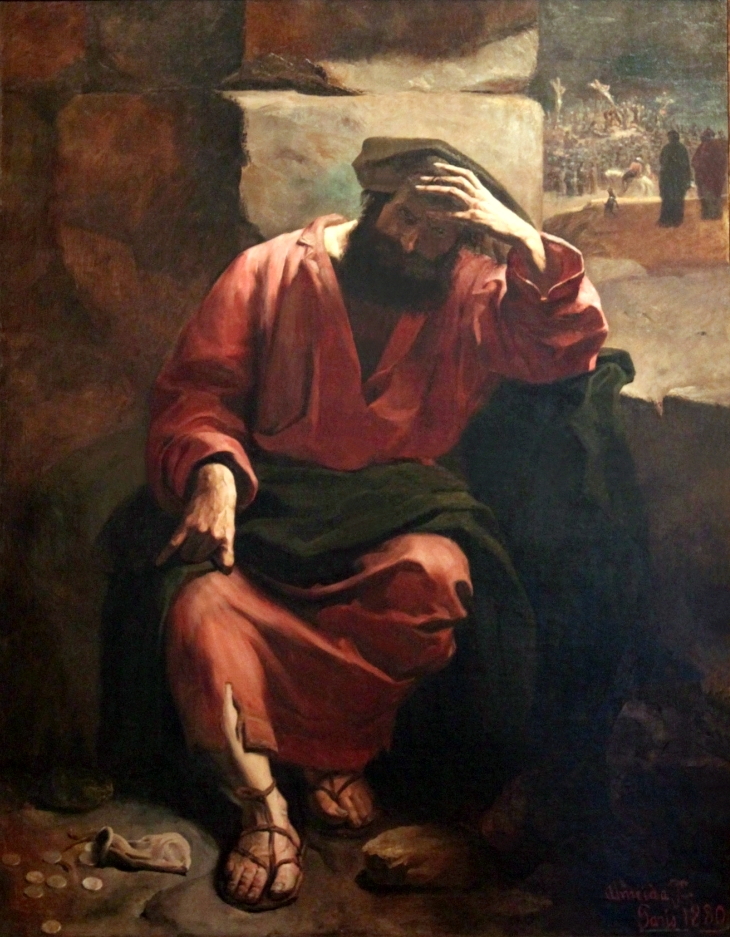
Jesus chose him freely (Fr. Patrick van der Vorst)

    Judas was among those Jesus wanted. Jesus chose him freely, just as he chose the others. There is no suggestion that Jesus deliberately selected a betrayer; instead, he believed in Judas’ potential for good and entrusted him with a real share in his mission, just as he did with the others. Jesus wanted Judas, and Judas accepted this call by his own free will... but in the end Judas did not ultimately want Jesus. 

   This dynamic touches our own discipleship. The Lord’s call comes to us again and again throughout our lives: “Come, follow me.” But our response must be freely given, continuously, consistently. He invites us first to companionship, to live close to his heart in prayer. From that friendship springs a mission: he sends us out to share what we have received. The call and response constantly get renewed and refreshed. Like the twelve, we are wanted by Christ; the question becomes whether we want him in return, and whether we consistently say 'yes' to his call at every stage in our life. 

 --Fr. Patrick van der Vorst 

Image source: José Ferraz de Almeida, Jr., The Remorse of Judas (1880),  
https://upload.wikimedia.org/wikipedia/commons/d/d1/Almeida_J%C3%BAnior_-_Remorso_de_Judas%2C_1880.jpg
Quotation source and commentary on this painting