Tuesday, July 21, 2026

Could God's love really be that great? (Fr. Richard Rohr)


    The ego prefers a dualistic worldview where bad people are eternally punished, and good people (like ourselves) are totally rewarded. But the soul does not need to see others punished to be happy! Why would anyone like the notion of somebody being tortured for all eternity? What kind of psyche or soul can condemn others to hellfire? Certainly not Divine Love. 
 
    Could God’s love really be that great and universal? Could it be anything less? Love is the lesson, and God’s love is so great that God will finally teach it to all of us. Who would be able to resist it once they see it? We’ll finally surrender, and God—Love—will finally win. God never loses. That is what it means to be God. That will be God’s “justice,” which will swallow up our lesser versions of retributive justice. 

--Fr. Richard Rohr,
Center for Action and Contemplation,
March 7, 2026

Monday, July 20, 2026

Everything is turned upside down (Henri Nouwen)


    The Kingdom is where everything is turned upside down. Those who are marginal, those considered not respectable, are suddenly proclaimed as the people who are called to the Kingdom. The part of us that is weak, broken, or poor suddenly becomes the place where something new can begin. 

    Jesus says, “Be in touch with your brokenness. Be in touch with your sinfulness. Turn to God because the Kingdom is close at hand. If you are ready to listen from your brokenness then something new can come forth in you.” 

--Henri Nouwen 

Sunday, July 19, 2026

Thriving in God's garden (Rev. Shirley Ruedy)

     I was flipping through a garden magazine last week when I came across this advertisement for a weed whacker. The ad read, “Effortlessly tackle tough weeds with braided carbon steel blades. The trimmer tackles tough weeds effortlessly. Save time with easy set-up. Keep every space looking its best. It can handle anything outside, giving you a beautifully maintained garden you can be proud of.” 

     Makes it sound easy, doesn’t it? A perfectly manicured and weedless garden. Well, not perfect and certainly not weedless. That will not happen. Until the harvest time according to Jesus’ eschatological vision, when the darnel and the wheat will be separated—at the end of the age. 

     But what about now? How are we to live? Jesus teaches that the kingdom is not yet fulfilled. That is yet to come. In the meantime, the world is complicated, with many questions unanswered or unanswerable. We live among the good and the evil and the somewhere in between. There are the redeemed, the believers, and the committed. There are also the unredeemed and the uncommitted. 

     But who are we to judge the human heart? To separate the wheat from the weeds? That will be up to the Sower, the Son of Man. Jesus teaches that the kingdom of God is a gift of divine grace offered to all of those willing to receive it and commit to it. Thriving in God’s garden among the weeds, our own included, with unexpected visits from the unidentified enemy, requires our patience, forbearance, acceptance of God’s grace, and above all, our love—all that he modeled when our Lord lived among us. 

     So let us truly see in order to perceive, truly listen in order to hear, truly keep our hearts alive and able to understand the eternal message of the Lord: 

     “Repent, for the kingdom of God is at hand.” 

—The Rev. Shirley Ruedy,
Deacon, Trinity Episcopal Church of Staunton

Image source: https://thegoodheart.blogspot.com/2011/07/priorities-wheat-or-weeds.html
Quotation source

Saturday, July 18, 2026

Thirsting for God's justice (Fr. Greg Boyle / St. Hildegard of Bingen)

Real justice restores
by loving people
into their wholeness.

--Fr. Greg Boyle

    Thirsting for God’s justice, believers should now suckle the holy element from God’s breast and never have enough of it, so that they will be forever refreshed by the vision of God…. When we grasp justice in this way, we shall surrender to it, taste virtue and drink. We shall be strengthened by it. 

--St. Hildegard of Bingen 

Image source: Galya Stambolieva, https://galyastambolieva.com/artworks/breastfeeding-art/woman-nursing-child-i/
Quotation 1 source
Quotation 2 source

Friday, July 17, 2026

Sunday Gospel Reflection, July 19, 2026: Your might is the source of justice...

Your might is the source of justice…
Just how open is God’s kingdom? 

    Jesus spends a lot of time in Matthew’s Gospel teaching the crowds about the kingdom of heaven, particularly through the use of parables. We are pretty familiar with the image of the mustard seed, which grows into a large bush where the birds of the sky come and dwell (ordinary mustard seeds do nothing of the sort!) and the image of the yeast, which suggests that God’s kingdom expands in ways we cannot imagine. More complex is the parable of the weeds among the wheat, in which good seed grows and bears fruit, but darnel, a pernicious weed, grows as well. When asked, Do you want us to go and pull the bad weeds?, the master gardener instructs his workers, No, if you pull up the weeds, you might uproot the wheat with them. God is patient, not judgmental; like the farmer, God is willing to wait until all have a chance to show themselves. And, as Psalm 86 reminds us, the Lord is good and forgiving, open to all who seek to live in right relationship with him. 

    This notion of God’s expansive compassionate justice is announced in the Book of Wisdom as well. Though you are master of might, you judge with clemency, the author of Wisdom states, and with much lenience you govern us. Rather than simply annihilate the enemies of God’s people, God gives all good ground for hope because God permits repentance for sins, not only to the people of Israel, but to all. God has the care of all. Moreover, should we ever be tempted to impose our own judgment, we should remember what Paul tells the Romans: the Spirit comes to the aid of our weakness. The Spirit joins us in our groanings, enabling us to pray for our world and its sinful brokenness. God is the one who searches hearts, and only God is called to judge them. 

    Jesus’ parables reveal a secret: the reign of God is here and the reign of God works more profoundly than we could possibly imagine! We are called to do whatever reveals his love – to let him rule our lives, direct our hearts, rule our hearts. In so doing, we will see that reign dawn and division decrease. But if we give into fear, we lose the very thing we put our faith in. It’s God’s way we follow, God’s justice we enact… not our own. And God’s kingdom is large enough to hold all! 

This post is based on Fr. Pat’s Scripture Class.
Image source: www.wordclouds.com

Thursday, July 16, 2026

Mary unties our knots (Pope Francis)


Today is the Feast of
Our Lady of Mount Carmel,
the Patroness of our parish!

       Marian devotion has a privileged place. Mary is an advocate, but these days the word advocate is too functional. It is better to say that she is a “facilitator.” Mary is a facilitator when conflicts and problems arise, such as the lack of wine at the wedding. She helps us to “untie the knots” that can be created in us and between us. In other words, Mary also paves the way for friendship between peoples, inviting us to turn our gaze to the origin and goal of our existence, which is Jesus Christ, and encourages us to follow His example, walking the paths of peace, kindness, listening and patient and trusting dialogue. 

--Pope Francis 


Image source 1: Our Lady of Mount Carmel banner, sewn by Gail Angiulo, OLMC-Mill Valley (2023), https://www.facebook.com/photo/?fbid=673482714817146&set=a.673491021482982
Image source 2: Johann Georg Schmidtner, Our Lady, Untier of Knots (1700), https://en.wikipedia.org/wiki/Mary,_Untier_of_Knots#/media/File:MaryUntier.jpg
Quotation source

Wednesday, July 15, 2026

We must tend the soil of our hearts (Fr. Patrick van der Vorst)

    We must tend the soil of our hearts. Faith is God’s gift, but we have a part to play in nurturing it. Prayer is one of the richest nutrients for this soil: our personal prayer, spoken in the quiet of the heart, and the shared prayer of the believing community. In today’s Gospel, the “good soil” is described as those who hear the word with a noble and generous heart. Prayer disposes us to receive the Word in this way, creating the environment where the fragile seed of faith can take root, deepen, and bear fruit in abundance. 

   We can think of faith as a garden entrusted to us. The seed has already been sown by God, but it is prayer that waters it, Scripture that gives it light, and love that keeps the weeds away. If we tend this garden faithfully, the seed of faith will not just survive, it will flourish, bearing fruit beyond our expectations. 

--Fr. Patrick van der Vorst,
Christian Art,
September 20, 2025

Image and quotation source: Claude Monet, The Artist's Garden at Giverny (1900),  https://christian.art/daily-gospel-reading/luke-8-4-15-2025/

Tuesday, July 14, 2026

It would explode our minds (Dwight L. Moody / Robert Cording)

Give your life to God;
he can do more with it
than you can.

--Dwight L. Moody

      We live in a goodness that we can’t explain – that is excessive, that’s mysterious, and that, if we paid attention to it, it would explode our minds. 

--Robert Cording 

Image source: https://heathercking.org/2019/01/28/bible-verses-about-the-abundance-of-god-2/
Quotation source 1
Quotation source 2

Monday, July 13, 2026

God's hand (Paula Nelsen)

    A few days ago, I saw to my horror that I had let my little houseplant garden dry up. Most of the plants in the pots were sadly wilted and looking dead. I had been so preoccupied by projects that they had slipped my mind. So, I watered them, soaked them, and hoped for the best. The very next day, they had transformed, almost like magic – the Christmas cactus, the shamrock, the orchid and the begonia all suddenly bloomed with bright little flowers. I was suddenly relieved. 

    Finally, when I sat down to read [Isaiah 55], it all seemed so simple and clear. Outside, the rain was pouring down. Inside, I was reading: Just as from the heavens the rain and snow come down, and do not return there till they have watered the earth, making it fertile and fruitful… so we can plant seeds, make bread, and eat! The rainstorm no longer looked dreary. I could see its incredible beauty and its incredible, beautiful power, and God’s hand behind it. 

--Paula Nelsen,
Communion Service Reflection,
February 20, 2024

Image source: https://www.reddit.com/r/houseplants/comments/14p5lgt/are_these_plants_dead_housesitting_concerned/

Sunday, July 12, 2026

Everything is possible (Pope Leo XIV / Corrie Ten Boom)

The fruitfulness of Christian life
does not depend on human approval,
but on the perseverance of those who,
united to Christ like the branch to the vine, 
bear fruit when their season comes.

 --Pope Leo XIV

    The wonderful thing about praying is that you leave a world of not being able to do something, and enter God’s realm where everything is possible. He specializes in the impossible. Nothing is too great for His almighty power. Nothing is too small for His love. 

--Corrie Ten Boom 

Image source: A leaf sheep (Costasiella kuroshimae) is a sea slug that is believed to be able to perform photosynthesis. It is no bigger than a grain of rice, yet God has made it able to pull off one of nature’s craziest tricks! Each one of its green “leaves” is covered in chloroplasts taken from the algae it eats (a phenomenon bearing the terrific name of kleptoplasty). Once it has fed, the leaf sheep stores these chloroplasts inside its body, allowing it to convert sunlight into energy – just like a plant. https://kottke.org/26/04/the-leaf-sheep-slug-the-animal-that-eats-sunshine for more details. In God’s realm, everything is possible!
Quotation source 1
Quotation source 2
Note: Corrie Ten Boom knew something about the impossible that God could accomplish through human participation in God's works. With her family, Ms. Ten Boom helped to save the lives of hundreds of Jewish refugees to the Netherlands during World War II. She herself was eventually arrested and sent to a concentration camp, but she survived and became a significant Christian writer and speaker.

Saturday, July 11, 2026

Unlimited seeds (Fr. Ron Rolheiser)


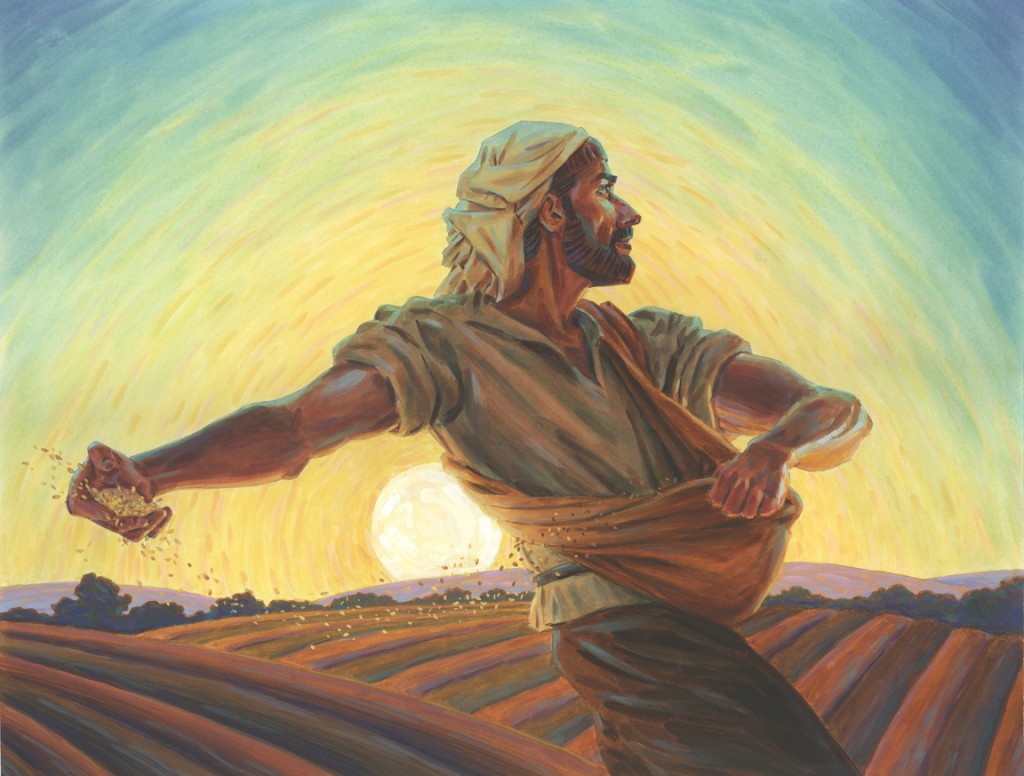
    The God of the Gospels is the Sower who has unlimited seeds, and scatters those seeds everywhere without discrimination: on the road, in ditches, in the thorn bushes, in bad soil, and in good soil. This prodigal God gives us this perennial invitation: Come to the waters, come without money, come without merit… because God’s gift is as plentiful, as available, and as free as the air we breathe. 

--Fr. Ron Rolheiser, OMI
Facebook, June 12, 2023


Friday, July 10, 2026

Participating in God's work (Suzanne)

    Every human relationship is dependent on dialogue – on how we speak to each other, how we listen, how we communicate. And so it is with God. Communication with the Lord requires that we pay attention to God’s Word in our lives and enter into dialogue regularly with God. 

    However, in Isaiah 55, God says, My thoughts are not your thoughts, nor are your ways my ways… For as the heavens are higher than the earth, so are my ways higher than than your ways, my thoughts higher than your thoughts. 

    This would seem to doom human communication with God to failure. Can we even begin to understand God, God’s thoughts, God’s ways? 

    One little word turns the tide: YET… Yet just as from the heavens the rain and snow come down… That little word, yet, is important… because it suggests hope! You may not understand me, God says – my thoughts and my words – yet I will send my word forth from my mouth and it will do what I want it to do: It shall not return to me void, but shall do my will, achieving the end for which I sent it. 

    And we can participate!

    If God is sending God’s word, God must be sending it to someone – namely, us. Which means, implicitly, that there must be some way to “get it,” some way for us to get an inkling of God’s message, because God wants to communicate with us, be in relationship with us, allow us to participate in God's work. 

    This can only happen if we are open to God’s purpose, open to God’s will in our lives. Only through constant communication with God can we find our way to God’s kingdom, both here on earth and in heaven, in synch with God’s ways, in tune to God’s thoughts. Only by listening can we know God’s will and participate in God's work. Only in prayer can we be open: open to the salvation that is ours, open to the joy the Lord promises to the just… 

--Suzanne T.,
Communion Service Reflection,
March 7, 2017
 

Image source: John August Swanson, Abraham and Isaac (2025, posthumous publication), available for purchase at: https://johnaugustswanson.com/catalog/abraham-and-isaac-2025/?srsltid=AfmBOooRO4vvFY8V_nZbZnOO7UZKKXF6cUCBE0FZJ-T4ZvAoi38Rsgn9

Thursday, July 9, 2026

Sunday Gospel Reflection, July 12, 2026: Whoever has ears ought to hear...

Whoever has ears ought to hear…
 Are we really listening? 

    In Matthew’s Gospel, Jesus’ parable of the sower has one point and one point only: the kingdom of heaven is at work among you and is producing beyond anything you can imagine. Yes, Matthew records the early Church’s alternative, analogy-based reading of this parable, which has to do with all those seeds that “fail” and bear no fruit, but ultimately, as Jesus tells the crowds, the seed that falls on rich soil and produces fruit produces a hundred or sixty or thirtyfold – the fruitful harvest promised by Psalm 65 and then some. It is impossible, and the impossibility is the point! God can do things beyond human imagining, no matter the soil, no matter the conditions. God is at work. God is going to produce. God is going to bear fruit. So be open to God and to where God is leading. The blessing comes for those who participate in the miracle that God is unfolding – but it’s God who is at work, accomplishing this miracle. So open your eyes, open your ears, and hear his Word! 

    Jesus’ message echoes that of the prophet Isaiah, who reassures the people who have returned from exile in Babylon and are beginning to rebuild that God’s word will achieve the end for which God sent it. Isaiah’s message of hope and encouragement suggests that God knows prosperity will come through his word. Just as from the heavens the rain and snow come down and do not return there until they have watered the earth, making it fertile and fruitful, so God’s word accomplishes God’s works, and in God’s time. What God creates is extraordinary, beyond our comprehension; we have but to be open to all that God’s creation has to reveal to us. 

    Mankind tends to limit creation, its value and abilities, to limit what is possible for God. But God doesn’t, and God expects us to participate! As Paul tells the Romans, creation awaits with eager expectation the revelation of the children of God. God desires that all creation share in union with Christ, and so creation is groaning in labor pains, waiting to give birth to revelation. We eagerly anticipate the glory to be revealed to us in all its fullness, and so we live in hope… because our God is a God whose activity is fruitful beyond anything we can imagine! We have but to hear the word and understand it, allowing God to bear fruit in us to be that very revelation Paul describes! 

This post is based on Fr. Pat’s Scripture Class.
Image source: www.wordclouds.com

Wednesday, July 8, 2026

His heart is an open door (St. Margaret Mary Alacoque / Anne Costa)

I need nothing but God,
and to lose myself in the heart of Jesus.

--St Margaret Mary Alacoque, VSM

    Jesus does not wish his heart to be a mystery to us. Rather, his heart is an open door; he wears it on his sleeve for us, so to speak. He is meek, he is humble, and he makes himself vulnerable, as he is consumed by love for us and concern for our eternal destiny. 

--Anne Costa,
Healing Promises:
The Essential Guide to the Sacred Heart

Image source: Christ the Missionary Overlooking the World, Notre-Dame des Missions d’Epinay, https://eglisesduconfluent.fr/Pages/VIT-93Epinay-EglND.php
Quotation 1
Quotation 2

Tuesday, July 7, 2026

Accompanied on the journey (Fr. Dave Ghiorso / Henri Nouwen)

    Take my yoke and learn from me. 

    A yoke is a tool. It’s an instrument that binds two animals together. It’s kind of an unusual image for rest. 

    But you have to remember what Jesus is trying to get across here. Christian rest does not mean an escape from life, but to be joined to our Lord through this life. Jesus does not remove the burdens; he’s very clear on that. He says, I will give you rest, but then he tells you to take the yoke. He’s not going to remove every burden. What is promised is that he shares the burden and, in doing so, completely transforms it. 

    Jesus is not asking us to carry those crosses we have alone. When we let him walk beside us, when we let him steady our steps as we go forward, the weight changes. That is what is being promised. The burden is still there, but the crushing heaviness of it is not. What might have felt unbearable is now survivable. 

    And then he promises us, And you will find rest for your soul – that inner peace that comes from knowing that we are loved, we are held, we are accompanied on our journey. 

    Maybe today we are invited to slow down, to rediscover that gentle God who walks beside us. 

--Fr. Dave Ghiorso,
Homily, December 10, 2025 

Dear God, Speak gently in my silence.
When the loud outer noises of my surroundings
and the loud inner noises of my fears
keep pulling me away from you,
help me to trust that you are still there
even when I am unable to hear you.
Give me ears to listen to your small, soft voice saying:
“Come to me, you who are overburdened,
and I will give you rest....
for I am gentle and humble of heart.”
Let that loving voice be my guide.
 Amen. 

 --Henri Nouwen

Image source: https://whatthenwhynow.org/an-easy-yoke/
Prayer source

Monday, July 6, 2026

He came to rule from within (Fr. Patrick Michaels / Molly Hartle)


Christ didn’t come to rule over us;
he came to rule from within.
Because Christ did not come to rule as any other king.
 There was only one power he wished to exercise
and that was the absolute love of God for all.

 --Fr. Patrick Michaels,
Homily, April 30, 2026 

    [In Matthew 11: 25-30], Jesus seems to be saying something odd. Essentially, he thanks God for hiding his treasures from “the wise and the learned.” My first question upon reading this was “Wouldn’t the wise and the learned naturally see his treasures?” 

    But those aren’t the people Jesus is talking about. He’s talking about the Jewish elite (that is, the Pharisees and Sadducees). Jesus knows that the Jewish elite are not only going to try to undermine him but that eventually their judgement will lead to his crucifixion. We get a taste of this in Matthew 9 when Jesus heals a paraplegic by saying simply “your sins are forgiven.” Rather than seeing the miracle in Jesus’ astonishing healing, the Jewish elite say, “This fellow is blaspheming!” 

    So, Jesus is mad. Not at the Jewish elite per se, but at their own misguided attachment to the letter of the law. He knows that their inability to remain open to his teachings will cost them salvation. Thus, his reference to “the childlike” – the Jewish elite are anything but. 

    In the latter part of this gospel reading, Jesus speaks to the very people who have fallen under the Jewish elite’s perfectionistic adherence to Mosaic law—all those who “labor and are burdened.” Jesus offers them a simple, inclusive faith that doesn’t require an education. No doubt this is what he means when he says, “My yoke is easy, and my burden light.” 

    Here, Jesus opens the door for anybody and everybody to follow him, even those people who lack an education, social standing, and money. He himself was born into poverty, was unable to read and write, and had little to no standing in society. 

    Come to me, all you who labor and are burdened… 

--Molly Hartle,
Communion Service Reflection,
October 4, 2022 

Image source: Jesus challenges the Pharisees and Chief Priest, The Chosen, Season 5, Episode 3, https://www.thebibleartist.com/post/the-chosen-season-5-episode-3-bible-study-discussion-guide-exploring-the-chosen-with-small-group

Sunday, July 5, 2026

The heart of the gentle, humble Jesus (W.S. Gilbert / Dr. Wendy Wright)


Let your heart be your compass.

--W.S. Gilbert

     [In Salesian spirituality,] each devout person becomes such by conforming her or his heart to the heart of the gentle humble Jesus of the gospels. It is interiorly, within the core or heart of the person, that this conformity is to take place. The human heart, refashioned through prayer, loving relationships, and loving actions, becomes fashioned into the heart of the gentle, loving savior. Jesus will live in such a heart. Jesus is enfleshed in such a person’s life. Through the ‘devout’ Christian, Jesus lives and society is transformed. 

--Dr. Wendy Wright,
“Hearts Have a Secret Language”

Image source: https://www.facebook.com/groups/418091763063248/posts/1038651777673907/
Quotation source 1
Quotation source 2

Saturday, July 4, 2026

We still hope for freedom (Fr. Patrick Michaels)

     On this day each year, we try and remember what has been good in our journey as a country. The entrance of Europeans into this land was good and bad. It was good from the standpoint that it gave a place of religious freedom to those who were oppressed where they came from; it was a problem for the people who already lived here, who found that their land was slowly being taken from them, and they and their values and their way of life weren’t necessarily being incorporated into this new land. 

    As immigrants would continue to come to this land, they would struggle to make a go of it, and they did so because of their own courage, their own conviction, their own values. They built up, through hard work, a nation, prosperity, things they did not know in the lands that they came from. They built up so many things that are biblical. The sense of a concern for one another; that even though there was competition, there was also often one nationality taking under its wing another, helping them to make their way, helping them to find their place, helping them to establish themselves, building up slowly the fabric of a country, built upon the hope for freedom. 

    We still hope for this freedom, and we still work to build it up, and we celebrate what we have accomplished so far, what God has accomplished through us. 

    Our greatness as a country is in our vulnerability to one another and to our world. It is to be found in our weakness, where God has the opportunity to work, God has the opportunity to weave, God has the opportunity to create anew. Today we celebrate our own independence, the right to not just exercise our own freedom, but to make it available to all. 

    It is not a feast, a celebration, that is about us individually. It’s a celebration about us collectively, and when we see ourselves collectively, what we can achieve through the freedom that we won over and over and over again. This is a celebration of all that is best in us, which requires an acceptance of all that is not. And in owning all that is not, to transform it. God is at work in us, and for that, we give thanks. 

--Fr. Patrick Michaels,
Homily, July 4, 2025

Image source: https://daily.jstor.org/celebrating-immigration-on-the-fourth-of-july/

Friday, July 3, 2026

A store of meekness and kindliness (Fr. Ron Rolheiser / St. Francis de Sales)


True religion is, at a point,
about the size and quality of our hearts,
about how wide or narrow they are,
about how mellow or bitter they are,
about how forgiving or angry they are,
and about how much they can imitate God’s love
which goes out warmly and equally to all,
to the bad as well as the good.

--Fr. Ron Rolheiser, OMI

    Lay up a store of meekness and kindliness, speaking and acting in things great and small as gently as possible. Remember that the Bride of the Canticles is described as not merely dropping honey, and milk also, from her lips, but as having it “under her tongue,” that is to say, in her heart. 

    So we must not only speak gently to our neighbor, but we must be filled, heart and soul, with gentleness; and we must not merely seek the sweetness of aromatic honey in courtesy and suavity with strangers, but also the sweetness of milk among those of our own household and our neighbors; a sweetness terribly lacking to some who are as angels abroad and devils at home! 

--St. Francis de Sales,
Introduction to the Devout Life

Note: In Salesian spirituality, the word "meek" is most often translated as "gentle."

Thursday, July 2, 2026

Sunday Gospel Reflection, July 5, 2026: Take my yoke upon you, and learn from me...

Take my yoke upon you and learn from me…
Does Jesus rule your heart? 

     Christians generally look to the Book of the Prophet Zechariah as a prophecy about the coming of Jesus. Your king shall come to you, the Lord says through the prophet, a just savior, meek and riding on an ass. In his gospel, Matthew will use this very passage to describe Jesus’ triumphal entry into Jerusalem. But before Jesus gets there, no one seems to comprehend the nature of his kingship, particularly in the towns of Chorazin and Bethsaida where he has gone to preach. And yet Jesus prays: I give praise to you, Father, for although you have hidden these things from the wise and the learned, you have revealed them to the childlike. Jesus speaks a prayer of praise for all that is unfolding, all that will lead to the salvation God has promised. Even the obstinate failure of many to understand – which will lead to Jesus’ death – is part of that promise, for Jesus must offer all for the sake of all mankind. His is not the meekness of the weak, but the gentle, humble heart of our King who gives himself for expiation of our sins. 

    It is only once we open ourselves to that truth and allow Jesus to rule our lives that our vision can be expanded past the tangible and we can truly know him, know Christ. Take my yoke upon you and learn from me, for I am meek and humble of heart; and you will find rest for yourselves, Jesus says. It is invitation, not coercion. Jesus’ yoke is his love for us; to accept it is to open ourselves to his love and to allow him to dwell in us and rule our hearts. Our job is simply to let him steer and guide us.. Then we will find the kind of peace prefigured by Zechariah, when all the implements of war (the chariot, the horse, the warrior’s bow) shall be banished, and we shall shout for joy, praising God’s name forever, as Psalm 145 exhorts us to do. 

    How do we open ourselves to the truth of Jesus’ tremendous gift? As Paul tells the Romans, it is the Spirit of the one who raised Jesus from the dead who will give life to our mortal bodies also. If we live for the sake of the love revealed to us in Jesus Christ, if he lives in us through baptism, then we are participating in his love, and what we choose to do with our enfleshed bodies reveals that love. If we allow his Spirit to come and work within us, we are set free, and it is freedom that brings peace in the way that God has wanted to rule throughout all of Scripture – ruling our hearts with his love. 

This post is based on Fr. Pat’s Scripture Class.
Image source: www.wordclouds.com

Wednesday, July 1, 2026

Starved for stories of kindness (Robin Williams / Rosemerry Wahtola Trommer)


Everyone you meet is fighting a battle
you know nothing about.
Be kind. Always.

--Robin Williams

I could have said potato chips. Always true. Plain ones. No flavors. Potato. Oil. Salt. I could have said black licorice from Finland, also always true. Or long flowy pants with no front pockets. That’s new. Tending my eight aloe babies still recovering from their transplant. Counting orchid buds about to bloom. How many grams of protein in a serving of anything. The insane softness of my daughter’s inner arm. How baby swifts can fly ten months without stopping. Imagining Rodin and Rilke watching sunsets together. But what I said felt truest of all—I am starved for all stories of kindness. The young man delivering diapers to immigrant families in Maine. The woman sending socks to my friend with cancer. The stranger who walked a labyrinth with me. My husband offering me the last egg in the carton. Anyone who smiles and says hello in the grocery store aisles. Anyone who says hello back. 

--Rosemerry Wahtola Trommer,
"When They Asked Me,
'What Is Your Current Hyperfixation'”


Image source 1:  https://www.newhopeministry.info/blog/labyrinth-walking
Image source 2: Gerbrand van den Eeckhout, The Prophet Elisha and the Woman of Shunem (1664), https://www.mfab.hu/artworks/9145/
Quotation source
Poem source