Monday, July 16, 2012

Who is Our Lady of Mount Carmel?

The Feast of Our Lady of Mount Carmel

July 16 is the Feast of the patroness of our parish, Our Lady of Mount Carmel.  
So what exactly are we celebrating?

Tradition has it that on July 16, 1251, the Blessed Virgin Mary appeared to St. Simon Stock, a Carmelite friar, presenting to him the Brown Scapular.  Years ago, children were often given a small scapular on the occasion of their First Communion.  A brown scapular is made of two small pieces of cloth, usually with a prayer on one and an image of Our Lady on the other, joined by two thin connecting strips of cloth or ribbon.  The scapular is worn around one’s neck, with one part hanging in front and the other in the back.  Wearing the scapular daily is a sign of devotion to Our Lady.

According to the Catholic Encyclopedia, the feast celebrates Mary’s special care for those who are devoted to her, and who demonstrate that devotion by wearing her scapular.  A special grace of final perseverance is granted to them. 


The next time you are in OLMC, check out the stained glass window over the main doors to the church.  If you look carefully, you'll see a scapular in Jesus' hand (photo above)...

Prayer to Our Lady of Mount Carmel
O most beautiful Flower of Mount Carmel, fruitful vine, splendor of Heaven, Blessed Mother of the Son of God, Immaculate Virgin, assist me in this my necessity. O Star of the Sea, help me and show me herein that you are my Mother.  O Holy Mary, Mother of God, Queen of Heaven and earth, I humbly beseech you from the bottom of my heart, to succor me in this my necessity. There are none that can withstand your power. O show me herein that you are my Mother.  O Mary, conceived without sin, pray for us that have recourse to thee. (3 times).  Sweet Mother, I place this cause in your hands. (3 times)

Sunday, July 15, 2012

What's a dresser of sycamores?


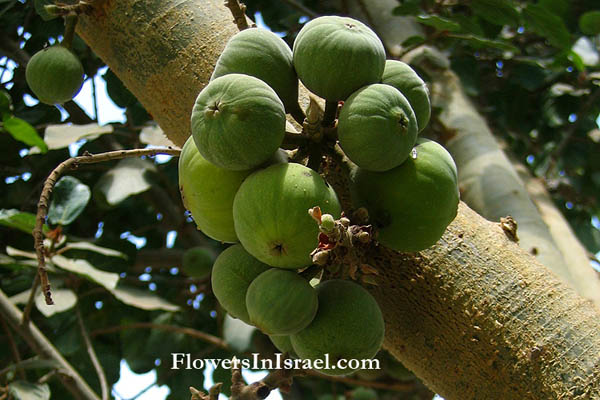
The sycamore tree mentioned in today’s reading from the Book of Amos is not exactly the kind we see growing on the street so named in Mill Valley.  The scientific name of Amos’s tree is Ficus sycomorus, and in the Middle East it’s also known as a fig-mulberry.  Its leaves are thick and leathery, and may have been the ones the writer of Genesis had in mind for the ersatz clothing invented in the Garden of Eden.  Interestingly, unlike our local sycamores, Amos’s trees bear edible fruit!  In the first century, Pliny the Elder wrote about them in his Natural History:

Its leaves resemble those of the mulberry in size and appearance. The fig produces its fruit not on branches but on the trunk itself, and the Egyptian variety is exceptionally sweet and seedless. The tree's yield is extremely prolific, but only when iron hooks are used to make incisions in the fruit, which otherwise does not ripen.  When this is done the fruit is picked three days later, while another fig forms beneath it; the tree thus has seven crops of very juicy figs in a single summer.

So when Amos tells the cult prophet Amaziah that he is a dresser of sycamores, he’s describing himself as one of the guys who went around piercing the fruit of the fig-mulberry, one by one, to induce the proper ripening.  This was his paid work, not prophesying.  I guess this means he was responsible for making life sweeter – an interesting counterpoint to his message to the Northern kingdom, which can’t have been easy to swallow at all.


Saturday, July 14, 2012

July 15th 2012: Sunday Gospel Reflection


In today’s Gospel we hear Jesus sending out the Twelve Apostles in pairs, to spread the Good News of Jesus by preaching to people of repentance. Why did Jesus tell the Apostles to preach about repentance? Isn’t sin a personal matter? Isn’t sin none of their (or our business)?

Yes and no. We should never judge other people, that is not our calling nor can we do so effectively since we don’t know each person’s heart. Yet, we believe, as St. Paul said, that all have fallen short of the glory of God and that each of us is called by God to become a more perfect person, a better version of ourselves and to help others become better too (this is the goal of friendship and marriage). Personal growth is a lifelong process that involves humility, regular self-reflection and prayer, connection to a community, and most importantly, a desire to be better. Remember: God is longing to forgive us and heal us if we let Him.


Many people mistakenly think that they are good enough or at least aren’t that bad and so they don’t feel the need to reflect on what they have done wrong, go to church or participate in the Sacrament of Reconciliation. Yet if we fail to be a people of conversion and reconciliation in our own hearts we will never achieve the peace and wholeness that God created us for, we will always be holding something back. If we never seek forgiveness or try to be better people then we will never effectively be able to create a more peaceful and loving family life or community or a more peaceful world.  

The starting place for prayer and right-relationship with God and others begins with saying “i’m sorry”. Recognizing ourselves as sinners as people who sometimes miss the mark is not a product of Catholic guilt but an unbloated and clear reflection of who we really are. We need others to help us see more clearly and to remind us of who God created us to be; we need a community/faith-family, a church. This is why we gather weekly in the Eucharist and begin by praying together I confess to Almighty God and to you my brothers and sisters that I have greatly sinned. This is our moment to really take an inventory of our week. Only when name and let go of our brokenness and sin together can we ever be in communion, in right-relationship, with God and one another.

Questions for Reflection and Discussion
-How do I spread the good news of Jesus?
-When do I reflect on my day, set personal goals for my life and examine how I am living?
-Who are the people that God is calling me to ask forgiveness from?
-Who are the people that God is calling me to forgive?
-When was the last time I went to the Sacrament of Reconciliation?


Friday, July 13, 2012

Called to Discipleship

Called to Discipleship

This summer OLMC is offering everyone an opportunity to participate in the “Called to Discipleship” series on Tuesday mornings (10:30-12) or evenings (7-8:30) in O'Brien Hall.  This past week, the topic under discussion was “The Church” – not as a static institution, but as a vibrant set of models to live by.

Class began with a meditation on a song by Amy Grant, followed by a challenge:  we were all asked to make a list of all the things we would look for in a church community if we were to move to a new town.  What we discovered as we shared these lists was the huge diversity of elements that make up what we call the Church, from the building to the liturgy to the community and its activities, including everything from proclamation to prayer.  Church, we found, is something we live, something we do, something we experience in and with one another, both at Mass and in our everyday lives.  Our discussion leader Mike shared Fr. Avery Dulles’ six models of the church with us, and we discovered how all of the traits we had mentioned as important to us in the notion of “Church” could fit into one or more of these overlapping domains:  Church as Mystery, as Community, as Sacrament, as Herald, as Servant, and as Institution. 

I think it’s accurate to say that all who participated in the conversation came away with a new appreciation for all of the ways in which we, as the Body of Christ, are the Church: we participate in its mystery, share in fellowship with the community, meet Jesus in the sacraments and in each other, and are responsible for passing on the Good News and serving those in need.  One, holy, catholic and apostolic Church – where we all have a place at the table!

All are invited to join us next week, when the topic of discussion will be “The Sacraments.”

Reflection from ND Vision Conference on Vocation

Visioning Vocation: The Art of Self-giving love

*Guest reflection thanks to vocation.nd.edu

Tony Oleck and other Vision mentors

Author: Mr. Tony Oleck


When it comes to discernment, I have often found myself waiting on my burning bush or pillar of fire. Part of me expected the Lord to speak to me in some defining way in an extraordinary moment of prayer. I have been waiting for the day and the hour in which I would suddenly know what I was meant to do for the rest of my life.
Working at Notre Dame Vision this summer, however, has radically transformed the way I imagine vocation and the way I see discernment. ND Vision is a program that seeks to help high school students recognize the gifts, passions and desires that God has given them, and how they can use them to discover God’s call in their lives and respond to that call with faith and courage. Students spend one week on Notre Dame’s campus listening to dynamic keynote speakers from all across the country and looking in-depth at the question of vocation in unique small group activities with mentors (like myself) from Notre Dame, St. Mary’s College and Holy Cross College.

The topics and themes explored at ND Vision have helped me to understand vocation and discernment in a whole new light. For example, what do we mean when we use the word “vocation”? One helpful definition of vocation that I have come to grasp through Vision is “the art of self-giving love.” Vocation can in part be understood as the way in which our lives become artworks of God’s love for the world. But what is self-giving love, exactly?
The self-giving love that the Christian is called to can be seen in the doctrine of the Trinity. The Holy Trinity teaches us so much about love and about vocation because it shows us that God truly is Love. The three persons of the Trinity teach us that God is relational, that His essence is complete self-giving Love. The Son perfectly loves the Father and the Father perfectly loves the Son, and from this love life is issued forth in the person of the Holy Spirit. Thus the three are one, yet distinct.
The mystery of the Trinity, though it is a mystery, teaches us a very fundamental truth about reality and the Christian's place in it. That is that God is Love, and the logic of the entire universe is Love. Thus as I discern my vocation, one of the primary questions I have learned I must ask myself is this: How is God calling me to participate in the Love of the Trinity? How can my life be a window into this self-sacrificial, life-giving Love?
While this is a question I am still asking myself as I continue formation in Holy Cross, learning how to ask the question and how to answer it has been one of the greatest gifts that the ND Vision community has given me this summer. One lesson I have quickly been learning is that God does not primarily speak in heavy storms or crushing rocks, in earthquakes or burning bushes, but rather the Lord speaks to the heart. The Lord whispers in the silence of our hearts, in our gifts, our passions, our desires. These desires must be fine-tuned, or rightly ordered, to virtue and to God’s will, but holy desires, gifts and passions can help us to discover this will and respond to it in love.
leadkindlylight
This is the beauty of the Communion of Saints! Stepping into the ND Vision community was like stepping into a giant stained-glass window. Each piece’s color is a little different. They vary in size. Some are more jagged, some more smooth. None are perfect on their own. Yet each piece is necessary and fits together with the others to offer a beautiful image for the light of Christ to shine through. This light pierces every shard of glass and creates a masterpiece of God’s love.
Discerning my vocation in the midst of these men and women has been incredible. It has been like trying to find my place in the stained-glass window. It has been such an inspiration to see the way that God is already using the gifts and personalities of the people I have been so blessed to spend my summer with. Seeing this has pushed me to look at my own gifts and personality, and to ask how I can best use them to glorify God and make His love known to the world. For me, this summer has been about learning to find my place in the Communion of Saints.
Mr Anthony Oleck
Mr. Tony Oleck is entering his third year at Old College Undergraduate Seminary on the campus of Notre Dame. He and his fellow Old Collegians write posts for the Spes Unica Blog, sharing on their life and formation in Old College. Learn more about seminary life in Holy Cross, and specifically Old College Undergraduate Seminary. And meet the current Old Collegians who are in formation for priesthood and religious life in Holy Cross. 

Thursday, July 12, 2012

So that we might exist for the praise of his glory...


Who can go out and proclaim the Good News?  This Sunday’s readings seem to suggest that the answer is:  anyone whose heart is open to Christ and who knows that redemption is at work in her or him.  This means you!

Neither the prophet Amos (a mere dresser of sycamores) nor the disciples around Jesus (fishermen, after all) are professional “proclaimers of the Word” – and neither are we.  But we all possess one thing in common:  the capacity to Love.  We aren’t necessarily secure in our inner selves, though we trust that redemption is at work in us.  But this is okay, because we all – proclaimer and audience alike – have to recognize our own need for the Good News, that is, our need for God, and for God’s Love in our lives, even as we proclaim it.  If we ourselves are transformed by that Love, then we can bring that Love to bear upon the difficulties of life, upon any challenge, upon the brokenness we encounter daily. 

St. Paul says, In him we have redemption by his blood, the forgiveness of transgressions, in accord with the riches of his grace that he lavished upon us.  Why?  So that we might exist for the praise of his glory.  At the end of every Mass, we go forth, we are sent, to share the word of truth even as we grow in our own understanding of that truth every single day.  Ite, missa est!


(This reflection is based on notes from Fr. Pat's Thursday night Scripture class.)