Brother Lawrence discovered that holiness does not depend on extraordinary circumstances, spiritual achievements or moral perfection. Instead, it flows from a simple, loving awareness of God’s presence in every moment.
Quotation source
Welcome to the parish blog of Our Lady of Mount Carmel Church in Mill Valley, California
Jesus enlightens the disciples on the road to Emmaus. Have you ever tried to solve a puzzle and then were surprised when the various pieces suddenly fell into place? Well, this is what happens to these disciples as Jesus begins to speak: “How slow of heart [you are] to believe all that the prophets spoke! Was it not necessary that the Christ should suffer these things and enter into his glory?” The whole of Christianity is hanging here in the balance.
The disciples didn’t get it at first. They didn’t get the secret, the mystery, the key, the pattern. And what was that? God’s self-emptying love, even unto death. God’s act of taking upon himself the sins of the world in order to take them away, the mystery of redemption through suffering.
Jesus explains this first by reference to the prophets; but then, he makes it as vividly present to them as he can: “He took bread, said the blessing, broke it, and gave it to them.” And that’s when the pieces fell into place—that’s when the puzzle was solved. The Eucharist made present this love unto death, this love that is more powerful than sin and death. The Eucharist is the key.
--Bishop Robert Barron
Image source: Pierre Loy, Emmaus, Eglise St Luc, Valais, Switzerland, https://www.facebook.com/groups/1785622648381496
Quotation source
Seeing God means being ready to see him in unexpected people, places and ways. It means living with our eyes and our hearts open. Because wherever you are, there is your Emmaus.
--Fr. James Martin S.J.
Image source: Georges Rouault, Road to Emmaus (1936), https://risdmuseum.org/art-design/collection/road-emmaus-20079813
Quotation source
There is a sanctity in literally breaking bread with others — whether it be for a special occasion or as part of an everyday routine. Regardless, being distraction-free and fully focused on the present moment — and God’s presence in our company — makes each meal full of grace.
Mealtimes emphasize the beauty of a community. Everyone takes time out of their busy lives to come together as one. It’s no wonder that Jesus chose a meal to establish the first Mass, the holiest of meals. In fact, every Mass is a meal. We gather together to listen to God’s word and eat and drink his body and blood in the form of bread and wine.
As Jesus literally broke bread [at the Last Supper seder meal], he told his disciples: “This is my body, which is given for you. Do this in remembrance of me” (Luke 22:19). He did it again as he passed around the cup of wine: “This cup that is poured out for you is the new covenant in my blood” (Luke 22:20). This was one of the most singularly important announcements in the world: that Jesus is fully present in the bread and wine that is shared in Mass, all around the world, from that very first seder meal to today.
--Veronica Szczygiel
Image source: Our Lady of Mount Carmel Parish Potluck, July 14, 2024, https://www.facebook.com/photo/?fbid=909846294514119&set=a.909848687847213
Quotation source
The Christian life is not lived in isolation,
confined to our minds and hearts.
It is lived with others,
because the Risen Christ is present among
the disciples gathered in His name.
We are part of a people,
a body that the Lord has established.
No one is a Christian alone!
--Pope Leo XIV, June 6, 2025
For some the idea of a universal welcome, in which everyone is accepted regardless of who they are, is felt as destructive of the Church’s identity. As in a nineteenth-century English song, ‘If everybody is somebody then nobody is anybody.’ They believe that identity demands boundaries. But for others, it is the very heart of the Church’s identity to be open. Pope Francis said, ‘The Church is called on to be the house of the Father, with doors always wide open ... where there is a place for everyone, with all their problems and to move towards those who feel the need to take up again their path of faith.’
This tension has always been at the heart of our faith, since Abraham left Ur. The Old Testament holds two things in perpetual tension: the idea of election, God’s chosen people, the people with whom God dwells. This is an identity which is cherished. But also universalism, openness to all the nations, an identity which is yet to be discovered. Christian identity is both known and unknown, given and to be sought. St. John says, ‘Beloved, we are God's children now; what we will be has not yet been revealed. What we do know is this: when he is revealed, we will be like him, for we will see him as he is.’ (1 John 3. 1 – 2). We know who we are and yet we do not know who we shall be.
For some of us, the Christian identity is above all given, the Church we know and love. For others Christian identity is always provisional, lying ahead as we journey towards the Kingdom in which all walls will fall. Both are necessary! If we stress only our identity is given – This is what it means to be Catholic – we risk becoming a sect. If we just stress the adventure towards an identity yet to be discovered, we risk becoming a vague Jesus movement. But the Church is a sign and sacrament of the unity of all humanity in Christ (LG. 1) in being both. We dwell on the mountain and taste the glory now. But we walk to Jerusalem, that first synod of the Church.
How are we to live this necessary tension? All theology springs from tension, which bends the bow to shoot the arrow. This tension is at the heart of St. John’s gospel. God makes his home in us: ‘Those who love me will keep my word, and my Father will love them, and we will come to them and make our home with them.’ (14.23) But Jesus also promises us our home in God: ‘ In my Father’s house there are many dwelling places. If it were not so, would I have told you that I go to prepare a place for you? (John 14.2).
When we think of the Church as home, some of us primarily think of God as coming home to us, and others of us coming to home in God. Both are true. We must enlarge the tent of our sympathy to those who think differently. We treasure the inner circle on the mountain, but we come down and walk to Jerusalem, wanderers and homeless. ‘Listen to him’.
We want to commit to creating
a culture and community of
cherished belonging.
--Fr. Greg Boyle SJ
How do we live out our common life as a God-centered, love-motivated community of faith? How will we express our particular faith in prayers and worship that include all people? How will we live our unity in authentic ways, fully recognizing the divisions and separations that continue to exist among us? My own growing awareness is that spiritual needs and desires are present and common to all, that we share a universal quest for deeper meaning and purpose, and that we are all beloved children of God.
--Henri Nouwen
Image source: OLMC’s “Chosen” group prays for our world, December 2025, https://www.facebook.com/photo/?fbid=1328667335965344&set=pb.100064662700877.-2207520000
Quotation source
Mary of Magdala, follower of Jesus… Mary, whose life was changed by Jesus… Mary, who was saved by Jesus… Mary had witnessed her Lord, her friend, ridiculed, beaten, whipped, and then, as she stood at the foot of the cross, she saw Jesus crucified. And Mary knows: she is so very helpless. She can do nothing.
It is little wonder that Mary is called to the tomb of her best friend. Rising early, eager to be with the crucified Jesus, Mary is the first to see the stone of the sepulchre has been moved. Mary runs back, telling Peter and the other disciples what she saw. Peter and the other disciple race to the tomb, finding indeed that Mary is correct: the tomb is open and Jesus is not there.
Quickly, the two disciples retreat from the tomb, trying to make sense of this open, empty tomb. Mary, still driven by her love for Jesus, returns to the tomb a second time, desperate for understanding. This first appearance of the resurrected Jesus might have included his Mother Mary, or Peter, the head of the disciples, or the Beloved Disciple. But no: this first sighting of the resurrected Christ is the honor given to Mary of Magdala, Mary, who has lived a life of sorrow and of loss, a woman who recently (because of the presence of Jesus in her life) knows of beauty and knows the joy of life. She is changed – hers is a life reclaimed, because of Jesus.
At the tomb, Mary sees the risen Christ, and Jesus speaks to Mary, calling her by name. He says, Stop holding onto me. Go to my brothers and sisters. And what does Mary do? Having longed to see the body of her Lord, to minister to him, what does she do? Mary does what is asked of her, and races to tell the other disciples what she has seen: Jesus, risen! Mary becomes the apostle, the messenger, to the other apostles.
We, like Mary of Magdala, are asked to go and tell our brothers and our sisters. Go, make a difference! We are the hands of Christ, reaching out to those in need, gentle, focusing hands, hands that will be of help to others, asking, what do you need? Do you need to be heard? Do you need to be hugged? Do you need to be helped? We are the face of God for all to see. Go…
Go, make a difference in our world, because the world needs you.
--Jackie Bacon,
OLMC Communion Service,
April 2, 2024
Image source: https://cbn.com/article/salvation/why-jesus-chose-mary-magdalene-proclaim-his-resurrection
The experience of the Risen One
must have been shocking,
deeply moving, and all-shattering.
--Fr. Gerhard Lohfink,
Jesus of Nazareth
Christ is risen, though we might not see him! The miraculous doesn’t force itself on us. It’s there, there to be seen, but whether we see or not, and what precisely we do see, depends mainly upon what’s going on inside our own hearts.
--Fr. Ron Rolheiser OMI
Easter Blessings from
Our Lady of Mount Carmel,
Mill Valley!
May your heart be full!
Image source: Resurrection, Church of Lord Jesus the Good Shepherd, Krakow, Poland, https://www.themayor.eu/en/a/view/krakow-now-boasts-the-world-s-largest-stained-glass-window-12495
Quotation 1 source
Quotation 2 source
My children, for us Easter must be the passing
from natural life to supernatural life,
the passing from ourselves to God.
--Fr. Louis Brisson
“Why do you look for the living among the dead?”
The angel said to the women at the tomb.
Lord, the angel says that to me too on this Easter.
For I too often dwell among the dead,
removing the scars on my hands and my feet
so that I might bleed again.
Revisiting past hurts,
Cherishing resentments.
Ashamed by my wounds.
Entombing myself in the past,
walking dead in the present.
“He has been raised!”
The angel said to the women and to me.
Jesus, give me the grace this Easter to believe
that your Resurrection doesn’t depend on me being perfect;
that your Resurrection is not conditioned by my being right;
that your Resurrection isn’t a reward for right behavior;
but the guarantor that a new way is possible,
a new road is now open,
and a new and eternal destiny lies before me;
that your scarred hand is stretched out before me,
waiting and desiring to grasp my bleeding hand,
as you invite me in faith,
to take hold of you and never let you go,
to embrace my wounds and not run from them
and to experience your Easter gift of new and eternal life,
Resurrection now and forever,
For once we are born into this world,
we never truly die.
Jesus, help me remember that,
no matter what happens,
You will always rise.
And,
with your grace,
so will I.
Amen.
May God be Praised!
Image source: https://www.religiousartdecor.com/jesus-is-laid-in-the-tomb/#iLightbox[gallery_image_1]/1
Source of quotations
Jesus notices the notice of God, then he becomes that notice in the world. Jesus receives the tender glance of the God of love and then chooses to become that tender glance. In today’s gospel, Jesus says, “I wash your feet, now, go and do the same.” It’s supposed to work this way. A homie finished an email to me the other morning with this: “Today, I will surrender into the arms of God, then choose to be those arms.” Exactly like that.
The invitation from Exodus is to “eat like those who are in flight.” The times in which we find ourselves, at the moment, do not lend themselves to leisurely dining. We can ill afford to “tune out” and block the news and the urgent call to be in the world who God hopes we’ll be: compassionate, loving and kind. We heal the divide not by winning the argument. After all, people don’t really “hold a view” but are rather…held by an anguish. The man who washed the feet that night knew that anguish is won over by love, by holding people with regard, a sturdy kindness and a steadfast delight.
The anguish is won over by love. The divide gets healed. We choose to be the arms of God and we wash feet. Lean in. Eat like you’re in flight.
--Fr. Greg Boyle SJ
Image source: Sadao Watanabe, Jesus Washing the Feet of St. Peter (1971), https://scriptum.com/artwork/19443-jesus-washing-the-feet-of-saint-peter?artistsid=1505
Quotation source
[In Luca Giordano's painting Agony in the Garden,] Peter, James, and John are asleep, ignorant of the cosmic event taking place no more than “a stone’s throw away” from them (Lk. 22:41). Only a few moments ago Jesus begged they “stay and watch with” him praying “not to undergo the test” (Matt. 26:38, 41). Yet here they lie, unaware of the Master’s plight and blind to his sacrifice.
How often do we lay asleep in the darkness of our own ego oblivious to the beauty right in front of us? How often do we fail to appreciate the miracles of daily life: the air we breathe, the rose fresh in bloom, the gleaming rays of sunrise and soft-hued tints of sunset? Or worse, how often do we attend Mass or receive the grace of the sacrament of Reconciliation without a proper gratitude alive in our hearts? All of these things are ways God loves us, ways in which his magnanimity is made manifest in our midst. Do we recognize them?
--Fr. Blake Britton
Image & quotation source: Luca Giordano, Agony in the Garden (c.1695).. https://www.wordonfire.org/resources/blog/beholding-beauty-giordanos-agony-in-the-garden/23466/
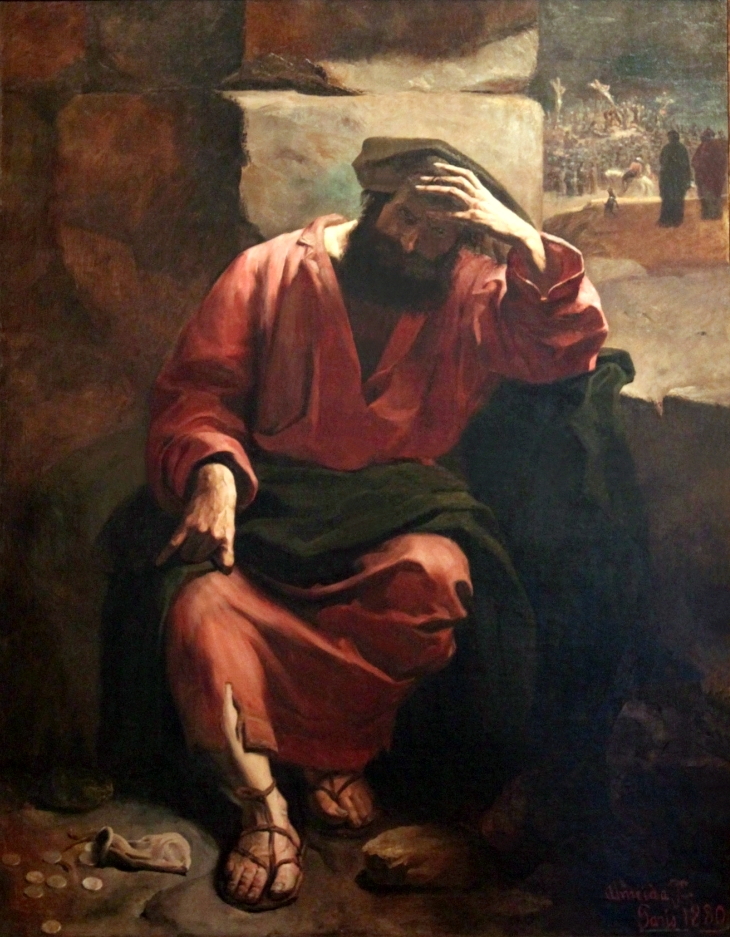
Judas was among those Jesus wanted. Jesus chose him freely, just as he chose the others. There is no suggestion that Jesus deliberately selected a betrayer; instead, he believed in Judas’ potential for good and entrusted him with a real share in his mission, just as he did with the others. Jesus wanted Judas, and Judas accepted this call by his own free will... but in the end Judas did not ultimately want Jesus.
This dynamic touches our own discipleship. The Lord’s call comes to us again and again throughout our lives: “Come, follow me.” But our response must be freely given, continuously, consistently. He invites us first to companionship, to live close to his heart in prayer. From that friendship springs a mission: he sends us out to share what we have received. The call and response constantly get renewed and refreshed. Like the twelve, we are wanted by Christ; the question becomes whether we want him in return, and whether we consistently say 'yes' to his call at every stage in our life.
--Fr. Patrick van der Vorst
Image source: José Ferraz de Almeida, Jr., The Remorse of Judas (1880),
https://upload.wikimedia.org/wikipedia/commons/d/d1/Almeida_J%C3%BAnior_-_Remorso_de_Judas%2C_1880.jpg
Quotation source and commentary on this painting